WHAT IS AN ACADEMY?
Academies receive funding directly from the government and are run by an academy trust. They have more control over how they do things than community schools. Academies do not charge fees.
Academies are inspected by Ofsted. They have to follow the same rules on admissions, special educational needs and exclusions as other state schools and students sit the same exams.
Academies have more control over how they do things, for example they do not have to follow the national curriculum and can set their own term times.
If a school funded by the local authority is judged as ‘inadequate’ by Ofsted then it must become an academy.
Academy trusts and sponsors
Academy trusts are not-for-profit companies. They employ the staff and have trustees who are responsible for the performance of the academies in the trust. Trusts might run a single academy or a group of academies.
Some academies are supported by sponsors such as businesses, universities, other schools, faith groups or voluntary groups. Sponsors work with the academy trust to improve the performance of their schools.
https://www.gov.uk/types-of-school/academies
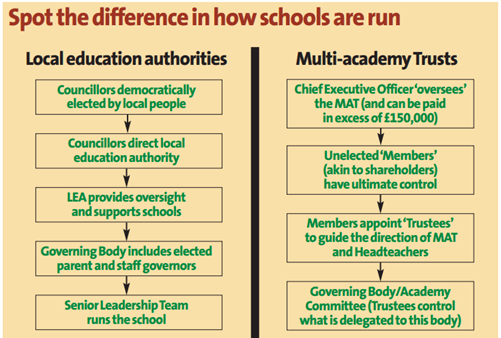
Spot the Difference image taken from the Anti-Academies Alliance Trust
Research on Academies
A 2018 report by researchers at the University College London (UCL) Institute of Education found there was no positive impact on the attainment and progress scores of pupils in MATs when compared to equivalent non-MAT schools. Pupils in larger MATs (those with 16-plus schools) did worse, particularly in secondary schools.
A 2019 study published in the British Journal of Sociology Education confirmed that academies are more likely than other schools to employ teachers who are unqualified and that the percentage of teachers without qualified teacher status (QTS) in academies is rising compared with LA schools.
Academies lose automatic support from the LA. Special educational needs, school improvement, and speech and language therapy services could all be lost, with no guarantee a MAT could offer the same support.
DfE data for 2021/22 shows that, on average, classroom teachers in both primary and secondary academies earned more than £1,300 less than their maintained school counterparts.
New staff joining an academy may not get the same terms and conditions as those who transferred when the school converted. While those staff who transferred have a legal right to maintain their pay and conditions on transfer, the pay and conditions for new joiners can be whatever the MAT determines.
Staff who move to academies can lose their built-up entitlement to maternity pay. Staff who later return to LA employment will have lost many rights, such as continuity of service, which is important for calculating sick pay.
 Stop the academisation of King Edward VII School